Smart and error-free tenders
A European provider of infrastructure and environmental technology supports public and industrial clients in the planning and implementation of complex projects in the fields of water management, civil engineering and sustainable infrastructure solutions. With a team of specialised experts and modern machinery, the company stands for quality, reliability and technical excellence.
The tendering process: complex, time-consuming, indispensable
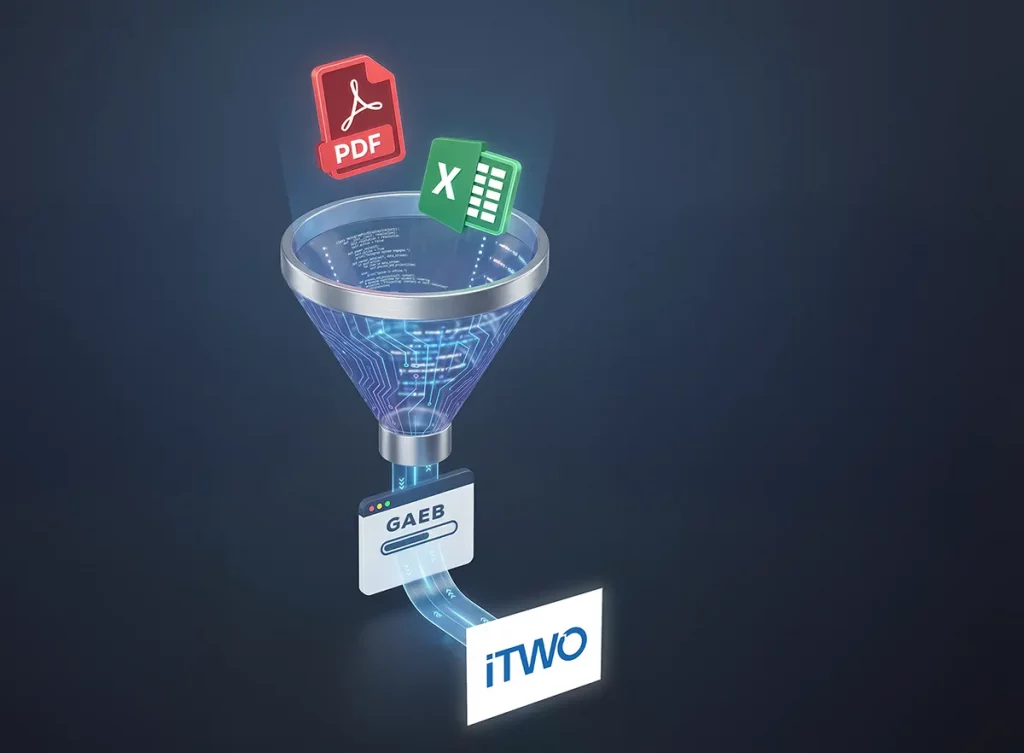
When we stepped in, the tendering process for our customers has been precise but very time-consuming. Together, we have developed a solution that revolutionises the entire process: automated processes standardise and translate Excel and PDF data in just a few minutes – ready for further processing in iTWO, the leading ERP software for construction projects and costing. The result: less effort, more efficiency and more freedom for what really matters: sustainable construction projects of the highest quality.
Optimising processes together
Large projects such as sewage treatment plants or pumping stations always start with a tender. For our customers, this means reviewing and processing extensive documentation. These usually consist of Excel files with itemised lists and lengthy PDF documents full of detailed descriptions. This presents two major challenges: different formats and a lack of standards.
Different formats and lack of standards
Tendering authorities, such as local authorities or engineering firms, work with their own formats. This makes further processing time-consuming, as PDFs in particular are often unstructured and non-standardised.
Crucial details in the long texts
The PDF documents contain essential descriptions that are indispensable for costing, such as specific requirements for materials or construction methods. This information is often missing from the Excel files and has to be laboriously extracted.
Overcoming language barriers
Many tenders are only available in French. However, these texts must be accurately translated into German for the calculation in order to avoid misunderstandings.
Intelligent processes for modern construction projects
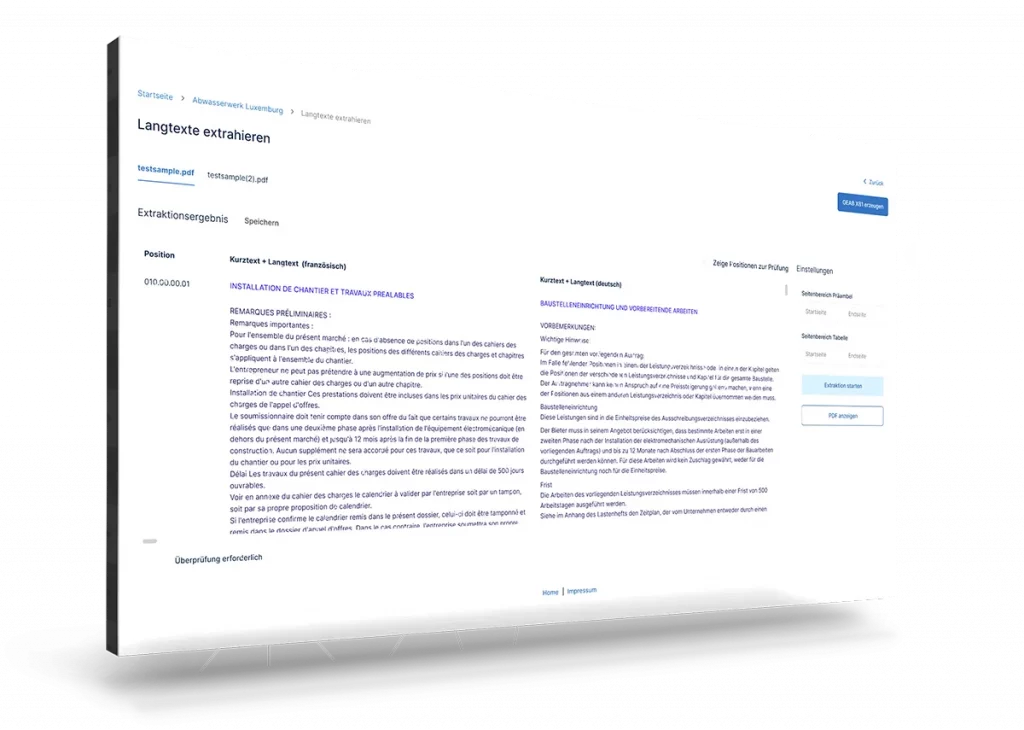
To simplify the complex tendering process, we worked with our customer to develop a solution that combines technology and practicality. The result is a cloud-based application that meets modern requirements – intuitive, efficient and with intelligent use of AI.
A system that adapts to its users
on Anfang an stand die Benutzerfreundlichkeit im Mittelpunkt. Eine klar strukturierte Weboberfläche sorgt dafür, dass komplexe Aufgaben einfach von der Hand gehen. Mit wenigen Klicks lassen sich Excel-Dateien und PDFs hochladen, ohne dass dafür technische Vorkenntnisse nötig sind. Die Anwendung funktioniert reibungslos, ganz gleich ob im Büro oder unterwegs – dank moderner Cloud-Technologie.
Structure data, generate GAEB files
The system automatically imports Excel specifications, processes them and creates standardised GAEB XML files. For our customers, this means that the data can be used directly in iTWO, the leading ERP software for the construction industry. This turns many individual parts into a structured whole.
When AI keeps track of everything
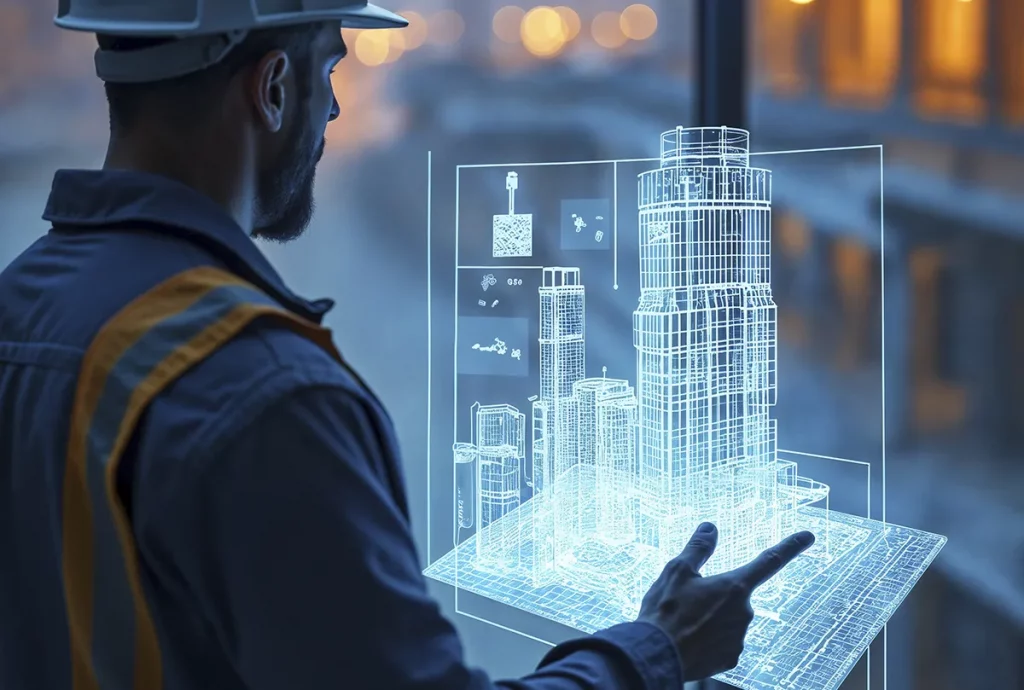
Unstructured PDF documents posed the biggest challenge. These often contain detailed descriptions that are crucial for the calculation. This is where artificial intelligence comes into play: the texts are precisely read, analysed and assigned to the appropriate positions. At the same time, the system automatically translates French descriptions into German so that no details are lost.
A tool for the future
This solution not only saves time, it also ensures greater security and reliability in the tendering process. What used to be tedious manual work can now be done in minutes – without losing track of the big picture. Our customer now has more freedom to concentrate on what matters most: sustainable, high-quality construction projects.
The benefits: more precise, faster, better
With the new solution, our customer has taken the tendering process to a whole new level. What used to be days of tedious manual work now takes just a few minutes – accurately and reliably. Sources of error have been minimised, and the time saved can now be devoted to core tasks: planning and calculating sustainable construction projects.
Digitization in the construction industry

Our collaboration with our customers demonstrates the potential that digitalisation offers. In the future, the focus will continue to be on further optimising processes and making sensible use of new technologies. The solution is more than just a tool – it is a step towards the future of construction.
Key elements of the solution
The joint solution delivers impressive results:
- Time savings
Processing time has been reduced from weeks to just a few hours. - Greater precision
AI ensures that no details are overlooked. - Uniform formats
All data is GAEB-compliant and can be used directly.
Facts & Tech
Tech Stack: Python, FastAPI, GCP, Cloud Functions, Firebase, OpenRouter, Anthropic LLM Modelle